A President's Demands on Aviation - Following Friday's nationwide FAA ground stop, progressive lawmakers demand oversight into the Modern Skies Act and a $30B lame-duck funding push.
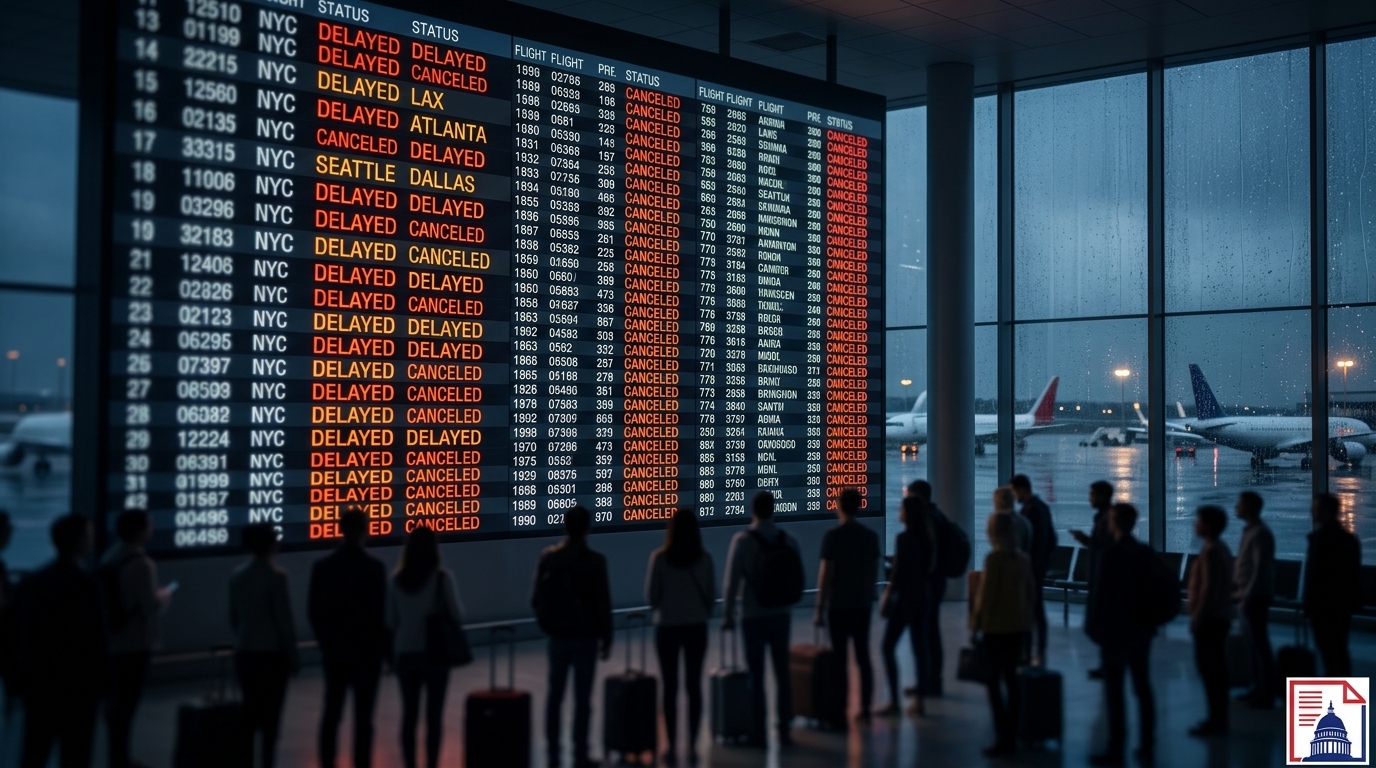
On Friday, November 13, 2026, a sweeping telecommunications failure at the Federal Aviation Administration (FAA) forced the agency to issue a rare nationwide ground stop. For more than four hours, commercial departures across the United States halted, stranding travelers ahead of the Thanksgiving rush. Almost immediately, the White House pivoted from crisis management to legislative pressure. By framing the crisis as justification for a $30 billion to $50 billion appropriations package during a lame-duck congressional session, critics argue the administration is effectively Holding America for Ransom: A President's Demands taking precedence over transparent technical accountability and legislative oversight.
Policy Summary: The November 13 Ground Stop and the Modern Skies Act
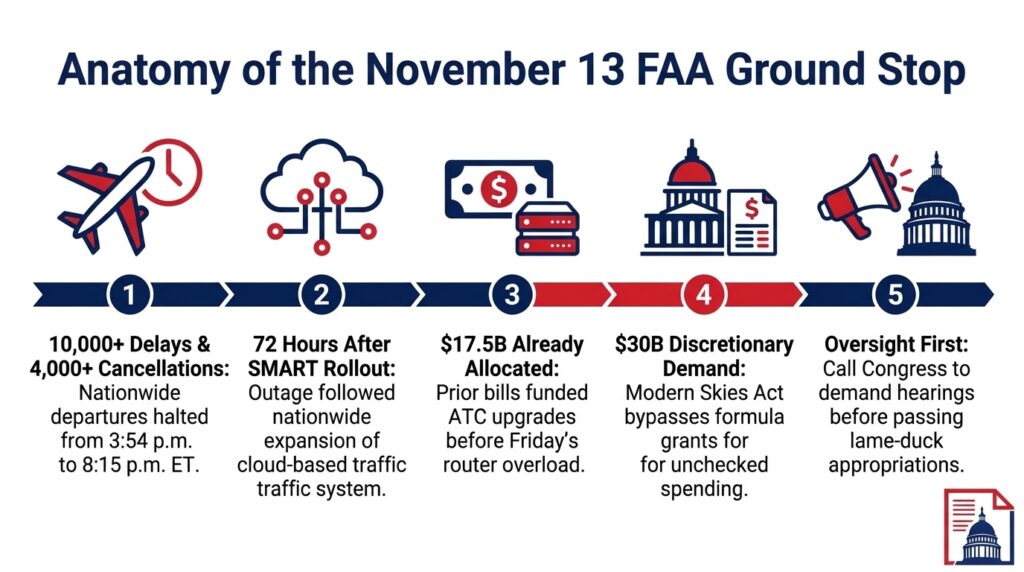
At approximately 3:54 p.m. Eastern Time on November 13, 2026, the FAA halted all domestic departures due to severe data inconsistencies across multiple Air Route Traffic Control Centers. While roughly 2,500 airborne flights safely landed under emergency protocols, the agency did not lift the restriction until 8:15 p.m. ET. According to flight-tracking data from FlightAware, the stoppage triggered more than 10,000 flight delays and over 4,000 cancellations nationwide.
During an evening press briefing, Department of Homeland Security (DHS) Secretary Markwayne Mullin and Department of Transportation (DOT) Secretary Sean Duffy ruled out a cyberattack or malicious intrusion. Instead, officials attributed the failure to an overload on legacy Time-Division Multiplexing (TDM) analog systems, copper telecommunications lines, and outdated switches and routers. Notably, the outage occurred just three days after the FAA expanded its cloud-based Strategic Management of Airspace, Routes and Trajectories (SMART) system—which centralizes 200 live data streams—across all 22 air traffic control centers nationwide.
Simultaneously, administration officials used the briefing to demand immediate congressional action on up to $50 billion in aviation funding, spotlighting the Modern Skies Act. Introduced by Senator Eric Schmitt (R-MO) on September 28, 2026, the legislation authorizes $30 billion divided into three $10 billion tranches: digital air traffic control architecture, legacy tower and facility overhauls, and a discretionary pilot program for airport terminal construction.
The Administration’s Defense
Proponents of the Modern Skies Act, including major commercial carriers and Republican leadership; Argue that the November 13 failure proves Congress has underfunded aviation infrastructure for decades. Secretary Duffy emphasized that controllers rely on 1980s-era copper wiring and aging analog switches, warning that similar outages could recur if the House and Senate do not pass emergency appropriations before the 119th Congress adjourns.
Timeline of the Crisis and Legislative Context
Examining the sequence of events reveals how recent agency rollouts and legislative deadlines converged on November 13:
- 2022–2025: Congress allocates $5 billion for air traffic control modernization under the Infrastructure Investment and Jobs Act, followed by a $12.5 billion down payment in the 2025 reconciliation package.
- September 28–29, 2026: Transportation Secretary Sean Duffy and FAA Administrator Bryan Bedford join Senator Eric Schmitt to unveil the Modern Skies Act, requesting an additional $30 billion for aviation infrastructure.
- November 10, 2026: The FAA announces the nationwide expansion of its cloud-based SMART system across all 22 air traffic control centers, centralizing 200 data streams into a single platform.
- November 13, 2026 (3:54 p.m. ET): Following data overloads on regional network routers, the FAA issues a nationwide ground stop—only the second total departure halt since September 11, 2001.
- November 13, 2026 (Evening): At a joint briefing, Secretaries Duffy and Mullin confirm there was no cyberattack, attribute the crash to overloaded routers, and urge Congress to pass up to $50 billion in modernization funding.
- November 13, 2026 (8:15 p.m. ET): The FAA lifts the nationwide ground stop, though cascading crew and aircraft disruptions persist through the weekend.
Core Analysis: Holding America for Ransom: A President's Demands vs. Congressional Oversight
From a progressive advocacy standpoint, the administration’s immediate pivot from an internal system failure to a sweeping appropriations ultimatum raises urgent governance concerns. While no verified evidence indicates deliberate sabotage—and DHS officials confirmed the ground stop was enacted out of an abundance of caution—the policy design of the Modern Skies Act and the timing of the outage demand strict legislative scrutiny.
First, technical and policy analysts have already flagged major structural flaws in the Modern Skies Act. Rather than allocating funds through predictable, formula-based Airport Improvement Program grants, the bill routes tens of billions of dollars into purely discretionary accounts controlled by the executive branch. Even more concerning, the bill authorizes $7.2 billion up front for digital architecture without standard multi-year appropriations oversight, while centralizing air traffic processing in cloud networks—a design aviation experts warn creates single points of failure capable of triggering nationwide outages.
Second, the FAA had already received $17.5 billion across recent legislative packages to address aging infrastructure. Furthermore, the November 13 router overload occurred just 72 hours after the agency expanded its data-intensive SMART platform nationwide. Demanding an additional $30 billion to $50 billion in discretionary funds before congressional committees investigate whether the agency's own cloud rollout overwhelmed legacy copper lines reverses the constitutional order of oversight.
Finally, rushing an unvetted spending package through the House and Senate Appropriations Committees during a lame-duck session bypasses public accountability. True infrastructure modernization requires transparent, formula-driven public investment, robust protections for air traffic controllers, and strict contractual guardrails on private vendors—not a blank check signed under the duress of holiday travel disruptions.
Conclusion and Call to Action
The November 13 ground stop exposed genuine vulnerabilities in America's aging aviation network, disrupting more than 14,000 flights. However, Congress must not allow an executive-branch technical failure to be used as leverage to pass a flawed, discretionary $30 billion spending bill without rigorous committee hearings and transparency.
Call to Action: Contact your Representative and Senators today. Urge them to publicly oppose the Modern Skies Act in its current form, refuse to advance any rushed lame-duck appropriations tied to it, and demand full House and Senate committee hearings to investigate the root causes of the November 13 outage and ensure taxpayer dollars are governed by strict public accountability rather than unchecked discretionary contracts.
U.S. Capitol Switchboard
Ask for any Senator or Representative by name. Tap the number to call on a phone.
Opened from a social app? If tapping the number does not start a call, copy it and dial it in your phone app, or open this page in your regular browser from the menu.
What the switchboard does
The Capitol Switchboard is a single public phone number that connects you to the Washington, D.C. office of any U.S. Senator or Representative. You do not need to know a direct line. You only need a name, and the next section shows you how to find yours.
Before you call
- Find out who represents you. Use the tool below: you have two Senators and one Representative.
- Pick one issue or bill. A short, specific call is easier for staff to log than a long one.
- Have your name, city and ZIP code ready. Offices prioritize constituents.
- Write down what you want in one sentence, such as "Please vote yes on H.R. ___".
Making the call
- Dial (202) 224-3121.
- When the operator answers, say: "Please connect me to Senator (or Representative) ___'s office."
- A staff member or voicemail will pick up. Stay polite and brief; the person answering records your message, they do not decide the vote.
- Give your name, city and ZIP, then your one-sentence message. Ask to have your position recorded.
- Thank them and hang up. Repeat for your other Senator and your Representative.
A script you can adapt
"Hello, my name is [NAME] and I'm a constituent from [CITY, ZIP]. I'm calling about [BILL OR ISSUE]. I'd like [SENATOR/REPRESENTATIVE NAME] to [SUPPORT / OPPOSE] it because [ONE REASON]. Please record my position. Thank you for your time."
Tips
- Lines are often busy during big votes. If you reach voicemail, leave the same short message.
- You can also call the member's district office near you (listed in the tool below) for local issues.
- Stay civil. Staff are people doing a job, and a calm message is more effective.
- The switchboard covers Congress only. For state and local officials, use the direct contacts the tool displays.
Sources
- FAA lifts nationwide ground stop that disrupted thousands of flights, White House says no indication of "nefarious act" - CBS News
- FAA ground stop raises questions after rollout of new AI air-traffic system - WBAL
- FAA orders nationwide ground stop for all US flight departures - The Kyiv Independent
- FAA General Statements: November 10 & November 13, 2026 - Federal Aviation Administration
- The Modern Skies Act won't modernize U.S. aviation - Reason Foundation
- Schmitt Introduces Modern Skies Act to Invest in America's Airports, Support Air Traffic Control - Office of Sen. Eric Schmitt

The team is a fusion of human curiosity, passion, and a relentless pursuit of truth—structured, prompted, and informed by Web-based AI. Every piece begins with a question, a spark of insight, or a challenge to conventional thinking. Through thoughtful collaboration between human intent and artificial intelligence, the content emerges as a reflection of both emotional depth and analytical clarity.
The goal is not just to inform, but to empower. By leveraging AI as a tool for exploration—not automation—the team can craft work grounded in facts, shaped by inquiry, and driven by a commitment to clarity and accountability.